• 619.866.3444
  • hello@socal.law
  • ProVisors
Gupta & Ayres
  • What We Do
    • Bankruptcy
    • Business Litigation
    • Real Estate Litigation
  • Who We Are
  • Our Team
    • Ajay Gupta
    • Jake Ayres
    • Samantha Hew
    • Elios Papa
    • Emilie Story
  • How We Help
    • Referral Partner Process
    • Legal Proceedings Process
  • Resources
    • The Blog
    • For Lawyers
    • Useful Forms
  • Get In Touch
  • Search
  • Menu Menu

Employer’s Liability for Independent Contractor’s Copyright Infringement

May 25, 2021/in All Blog Posts, Corporate Litigation/by John Ahn

You just hired a young web designer as an independent contractor to revamp your website.  After struggling through the creative process, you and your web designer ultimately come to a decision on the final product, and you launch your site. However, a few months later, you receive a letter from the Law Office of Koppi & Wright, PC accusing you of infringing on its client’s intellectual property—specifically pointing to a few graphics and photographs scattered throughout your homepage. Koppi & Wright demands that you remove the graphics and photographs from your website or else it will file a lawsuit against you and your business for copyright infringement.   

The main question is—did you do anything wrong?  Are you liable if the pictures and graphics are actually protected by copyrights?  After all, the web designer you hired placed the questionable graphics and photographs on the website—not you.  The simple answer to each of these questions is a resounding “maybe” depending on a few key circumstances, of course. 

Copyrights, In General 

Copyrights are a type of intellectual property that grants the owner or originator certain exclusive rights including the right to reproduce, copy, distribute, and perform the work created. (17 U.S. Code § 106.)  Specifically, copyrights protect original works of authorship including architectural, audiovisual, cartographic, choreographic, dramatic, graphic, literary, musical, pantomimic, pictorial, and sculptural creations. (copyright.gov.)

And to cover our bases, patents protect inventions and discoveries as opposed to works of authorship. (uspto.gov). On the other hand, trademarks generally protect names or logos that are associated with goods and/or services. (Id.).

As a general rule, if you want to use someone else’s property, you should probably ask for permission.  The same principle applies for intellectual property, and in this case, copyrights.  Once you receive permission from the owner or originator of the content or authored work, you should be able to use the work—such as a song or photograph—in your desired capacity.  For instance, if you wanted to use a certain artist’s photograph as a backdrop on your website, you may do so with the permission of said artist.  In another example, if you wanted to use the name and likeness of one of Disney’s fictional characters in your own business, you will need to get permission.  Conversely, any time you decide to go rogue and use someone else’s authored work without that person’s permission, you are likely infringing on a Copyright. 

Without getting too much into detail about fair use and other copyright exceptions (doing so would triple the length of this article), it is important to note that knowing when you are required to ask for permission can be a bit confusing.  This is especially true if your “use” of the copyrighted work is more than simply copying or reproducing the work.  For example, let’s say you wanted to take inspiration from a copyrighted work to create something of your own.  Do you need to ask the author/originator of that copyrighted work to begin creating?  The safe (albeit simplified) answer to that is “yes” unless you very clearly fall into an exception such as fair use.  Rogers v. Koons is a notable case addressing this very issue.  In Rogers, the court found that a sculptor’s faithfully copied sculpture of a copyrighted postcard photograph—which so blatantly copied the creative expression of the postcard photograph—did not fall under any fair use exceptions and therefore, constituted copyright infringement.  (Rogers v. Koons (2d Cir. 1992) 960 F.2d 301, 307.)  Although a sculptured version of a postcard photograph requires more work and transformation than simply photocopying, a faithful reproduction of an original copyrighted work can constitute copyright infringement.

Vicarious Liability of Copyright Infringement of Independent Contractors

We know that your direct actions can constitute infringement, but what happens when the infringement occurs due to a third party’s actions?  For example, what if the third party is the independent contractor you hired to create your website? 

In these instances, courts have held that anyone who has the “right and ability to supervise the infringing activity” of an independent contractor will be held vicariously liable for copyright infringement if he/she enjoys a “direct financial benefit from said infringing activity.” (See Rosen v. Martin. Cal. Apr. 19, 2013, No. CV 12-0657 ABC (Ex)) 2013 U.S.Dist.LEXIS 201985, at *12.)

In Rosen v. Martin, the court found the defendant had the ability to supervise the work of his independent contractors when they downloaded and uploaded copyrighted works without the Plaintiff’s permission.  (Id.)  Even though the defendant directed the independent contractors to not list these works again after the fact, the court still held the defendant vicariously liable for the independent contractors’ infringement.  (Id.)  In other words, even if your web designer is the one who actually infringed on an existing copyright, you could still be held accountable for the actions of your independent contractor. 

The “What Ifs” 

What if you completely unaware of the infringement?  Could you try to make the argument that as the employer, you did not know your independent contractor would or could be infringing on intellectual property?  The court in Hitek Software LLC echoed the ruling in Rosen but added that an employer who had the right to supervise the infringing activity would still be vicariously liable “even if the defendant initially lacks knowledge of the infringement.”  (See Hitek Software LLC v. Timios, Inc., (C.D.Cal. June 18, 2012, No. CV 12-709 CAS (AJWx)) 2012 U.S.Dist.LEXIS 86560, at *11.)  In Hitek Software LLC, the alleged infringement occurred when Timios, Inc. (the “Defendant”) employed an independent contractor computer specialist who installed software for the Defendant using an illegally generated product key and spoofing the software activation process.  (Id. at 3.)  However, the court determined that the Defendants had the right and ability to “oversee, govern, control, and direct” the independent contractor at all relevant times and was therefore liable for the independent contractor’s actions.  (Id. at 13.)  The idea here is that if you had the right and ability to supervise your independent contractor during employment, you should have known better and are not excused by your ignorance.

What if the independent contractor was simply negligent?  Would employers be absolved of liability?  As a general rule, employers will not be held vicariously liable for the negligent acts of their independent contractors.  (See Secci v. United Independant Taxi Drivers, Inc. (2017) 8 Cal.App.5th 846, 859 [214 Cal.Rptr.3d 379].)  This rule has a few caveats and exceptions like the peculiar risk doctrine, which states an employer can be held liable for an independent contractor’s negligence if the contractor was hired to perform work that is inherently dangerous, and the contractor’s negligence causes injury to others.  (Privette v. Superior Court (1993) 5 Cal.4th 689, 691 [21 Cal.Rptr.2d 72, 854 P.2d 721].)  However, assuming you haven’t hired an independent contractor for work that is inherently dangerous (and without getting into whether the court’s current view will continue to prevail) courts still generally view copyright infringement as a strict liability tort.  (See Educational Testing Serv. v. Simon (C.D.Cal. 1999) 95 F.Supp.2d 1081, 1087.)  Plaintiffs can merely show the defendant used their authored work without permission (e.g., copied, distributed, or performed) in order to prove a prima facie case of copyright infringement.  This essentially means that you will likely be unable to use your independent contractor’s negligence as a defense to vicarious liability for your independent contractor’s infringement.  

The takeaway here is simple: ask for permission.  When you are dealing with situations where you encounter authored work that catches your eye, and you plan on using the copyrighted material in some shape or form, make sure to ask for the owner’s permission.  Not all owners or originators of copyrights will ask for money.  In fact, many just want credit and recognition for their hard work.  If you don’t have the budget (or maybe you just don’t like talking to people), find something that is public domain including free stock images and try to make it work (because you don’t really have that many other legal options).  As an employer, make sure your independent contractor is taking the same precautions to avoid letters from firms like Koppi & Wright, PC to save yourself the headache. 
https://socal.law/wp-content/uploads/2021/05/markus-winkler-9XfSFjcwGh0-unsplash-1.jpg 1600 2400 John Ahn https://socal.law/wp-content/uploads/2025/11/GA-Logo-Header-Blue-300x119.png John Ahn2021-05-25 23:09:002026-04-08 15:27:08Employer’s Liability for Independent Contractor’s Copyright Infringement

Checking In On The Status of Residential and Commercial Leases in California

May 4, 2021/in All Blog Posts, Corporate Litigation, Real Estate/by Ajay Gupta

Vaccines are being administered, indoor and outdoor activities are beginning to resume throughout California and it would appear that life is starting to get back to normal.  Well, not quite.  Before you get ahead of yourself, a litany of COVID-related protections remain in place, namely in the landlord-tenant arena. The below is a quick refresher on the state of landlord-tenant protections in California, all of which must be considered before you seek to return to business (and evictions) as usual. 

SB 91 – COVID Eviction Protections Extended Through June 2021

Our last landlord-tenant summary focused primarily on California’s then recently passed Assembly Bill 3088, adopted at the end of August 2020 and formally known as the Tenant, Homeowner, and Small Landlord Relief and Stabilization Act of 2020 (“AB 3088”).  In short, AB 3088 was designed to protect residential tenants—not commercial tenants—who faced, and continue to face, economic hardship due to COVID-19.  With limited exceptions, the protections of AB 3088 apply to any tenant who is unable to pay all or part of their rent due to a COVID-19-related financial impact, so long as they provide an economic hardship declaration to the landlord within a specific period of time. A more detailed breakdown of AB 3088 can be found at our previous post here. 

Currently, the protections of AB 3088 remain largely in place.  Originally slated to protect residential tenants only through January 2021, the AB 3088 safeguards were extended by a second piece of legislation signed by Governor Newsom on January 29, 2021, known as Senate Bill (“SB 91”). The main thrust of SB 91 was to preserve the vast protections afforded by AB 3088 and extend its provisions another six months through June 2021.  As a result of SB 91, no residential tenant can be evicted before June 30, 2021, if the basis of the eviction is rent that has been unpaid due to a COVID-19-related hardship and the tenant attests such fact under penalty of perjury.  Additionally, if the tenant pays 25% of the rent owed from September 2020 through June 30, 2021, then the tenant cannot be evicted after the June 30, 2021 expiration.  Landlords will be able to recoup the remaining rent balance owed after June 30, 2021, via a reconfigured small claims court.  Alternatively, SB 91 also instituted a rental assistance program whereby residential landlords can apply to recover up to 80% of the unpaid rental balance through federal funds. 

Also remaining in place and a key point to keep top of mind, among other things, is the expansion of the “just cause” eviction requirement.  In essence, unless a tenant fails to attest to his or her COVID-related financial hardship, a residential tenant may only be evicted for either an “at-fault just cause” or “no-fault just cause.” In essence, unless a tenant fails to attest to his or her COVID-related financial hardship, a residential tenant may only be evicted for either an “at-fault just cause” or “no-fault just cause.”  In other words, whereas “just cause” was previously only required if certain length of possession thresholds were met (see Civil Code section 1946.2), AB 3088 extended just cause to all tenancies and this protection has been extended via SB 91.

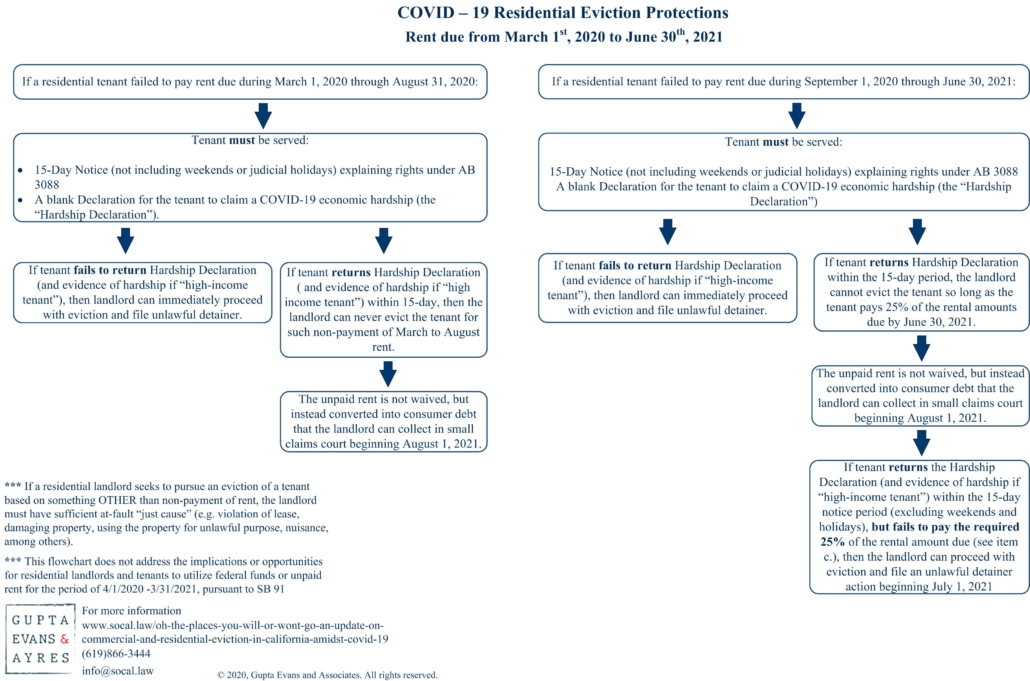
The foregoing is a relatively general and tremendously compressed explanation of SB 91 (and AB 3088), and a thorough review of the Bill’s intricacies is highly recommended. To assist in such review, our Firm has put together this simplified and updated version of our prior flowchart. 

Again, What About Commercial Tenancies?

Like AB 3088 that came before it, SB 91 did not extend eviction protections to commercial tenants.  As a result, commercial landlords and tenants should continue to look for guidance on whether a commercial eviction can proceed by turning their attention to the respective eviction moratoriums in place, if any, at the city and county levels. 

The City of San Diego (the “City”), for instance, currently has its own eviction moratorium in place that sets forth the specific rules and regulations that would either permit or prohibit a commercial landlord from pursuing the eviction of a commercial tenant.  The City of San Diego’s commercial eviction moratorium was re-adopted[1] on January 26, 2021 and will remain in place until June 30, 2021.  Under the City’s commercial eviction moratorium, a commercial landlord cannot endeavor to evict (e.g. serving 3-day notices, filing unlawful detainer) a commercial tenant for nonpayment of rent if the tenant gives the landlord written notice of its inability to pay rent on or within seven days after the rent payment was due. The tenant’s notice must specify that the inability to pay is due to financial impacts related to COVID-19.  The tenant will only be required to provide supporting documentation if the landlord asks for it within seven days of the tenant’s notice.  If notice is sufficiently given by the tenant, the commercial tenant will have six months (or until December 30, 2021) to pay the unpaid rental balance due. 

Our Firm has also put together a summary flowchart of the City of San Diego’s commercial eviction moratorium to help commercial landlords and tenants through avoid likely pitfalls.

Whereas the above only pertain specifically to the City of San Diego, if a commercial eviction moratorium is in place at your city or county levels, such moratoriums typically apply exclusively to the non-payment of rent scenario; but, landlords and tenants should carefully review each particular moratorium for the specific provisions, prerequisites and/or deadlines included in their respective moratorium, if any.  As of the date of this posting, eviction moratoriums are currently in place in Southern California in, among other places, Carlsbad, Los Angeles County, and San Bernardino County.  Notably, San Diego County does not have an overarching eviction moratorium in place; but, rather, such moratoriums, if any, are unique to the specific cities within the County.

Conclusion

As we near the end of the COVID-19 pandemic and begin to get back to business as usual, it is important to be cognizant of the fact that many COVID-related legislative actions and changes, particularly in the landlord-tenant space, will likely remain in place for months, if not years, to come.  The landscape will continue to shift, and landlords and tenants should continue to look for the most recent updates with respect to how best to proceed, or not proceed, in the context of evictions.

The materials available at this web site are for informational purposes only and not for the purpose of providing legal advice. You should contact your attorney to obtain advice with respect to any particular issue or problem. Use of and access to this web site or any of the e-mail links contained within the site do not create an attorney-client relationship. The opinions expressed at or through this site are the opinions of the individual author and may not reflect the opinions of the firm or any individual attorney. 


[1] Oddly, the City of San Diego’s prior commercial eviction moratorium expired on September 30, 2020, and many commercial evictions were able to move forward given the gap in protection between October 1, 2021 through January 25, 2021.

https://socal.law/wp-content/uploads/2021/05/scott-graham-OQMZwNd3ThU-unsplash-scaled.jpg 1709 2560 Ajay Gupta https://socal.law/wp-content/uploads/2025/11/GA-Logo-Header-Blue-300x119.png Ajay Gupta2021-05-04 23:39:002026-04-08 15:28:27Checking In On The Status of Residential and Commercial Leases in California

Bid Protests and Damages Availability

February 26, 2021/in All Blog Posts, Corporate Litigation/by Jake Ayres

You’re a seasoned litigator and an aggrieved, hardworking contractor comes into your office (or your Zoom room).  His recent proposal to the City, which was prepared with painstaking detail and offered the lowest bearable price, was rejected—unfairly, the contractor says.  Instead, the City awarded the contract to the contractor’s bitter rival, Dewey/Cheatham, who appears to have a cozy relationship with the City manager.  The contractor got second place.

After poring through the evaluation, it’s clear to you that the award process was far from fair, if not downright biased toward Dewey/Cheatem.  Your potential client is incensed—the contractor wants to file a lawsuit to give those so-and-sos down at City hall a piece of his mind—and to recover the profits he anticipated receiving under the contract.  He asks you: can he recover lost profits damages in bid protest litigation?

You respond in typical, equivocal fashion: probably not.  But also maybe.

A disappointed bidder who responded to either a request for proposals or an invitation for bids is not in a contractual relationship with the government entity requesting bids or proposals, which rules that claim out as a basis for recovering lost profit damages.  Moreover, because bid documents always allow for the government entity to reject all bids, tort claims, such as fraud, are also ruled out.  The case law in California has recognized this quirk, instead sanctioning claims by disappointed bidders on promissory estoppel theories—but only allowing damages for the costs of preparing the bid or proposal.  See Kaijima/Ray Wilson v. Los Angeles County Metro. Trans. Auth., 23 Cal. 4th 305, 314 (2000) (“Because the MTA was authorized to reject all bids, Kajima did not know at this point whether the contract would ever be awarded.  Nor, because of the secrecy of the bidding process, did Kajima know whether it was indeed the lowest responsible bidder.  Therefore . . . bid preparation costs, not lost profits, were the only costs reasonably incurred.”); Eel River Disposal & Resource Recovery, Inc. v. Cnty. of Humboldt, 221 Cal. App. 4th 209, 240 n.12 (2013) (“[A] bidder deprived of a public contract, by the wrongful misaward of that contract, has neither a tort nor a breach of contract action against the public agency.”).

Although Kajima and its progeny have spoken fairly authoritatively on this issue, there remains a glimmer of hope for disappointed bidders that is yet to be conclusively addressed in California courts: whether the presence of bad faith on the part of the government entity entitles a disappointed bidder to recover lost profits damages.  The court in Kajima held that lost profit damages were not allowed in the case at bar, noting that it was a “distinctly minority position” to allow lost profits as damages, and that the courts that had done so awarded those damages where bad faith was shown on the part of the government entity.  Kajima, 23 Cal.4th at 320.  The daylight in Kajima is that while the court in that case said that lost profits were not available to the plaintiff (who had not shown or alleged bad faith), it did not affirmatively say that lost profits damages would not be reachable if bad faith had been shown by the plaintiff.  See id.  In other words, Kajima was taking the broader position that, generally speaking, lost profits damages are not available to a disappointed bidder under a promissory estoppel theory.  It did not speak to the more specific issue of whether lost profits damages are available when bad faith can be demonstrated. 

Nonetheless, while the California Supreme Court did not foreclose this possibility completely, the branding of that strand of persuasive authority as “a distinctly minority position” would seem not to bode well for disappointed bidders bringing those arguments in the future.  However, the case can be made that although the court in Kajima pointed out that the policy of competitive bidding statutes is to protect the public rather than the expectations of a disappointed bidder, awarding damages to a disappointed bidder who is a victim of bad faith actions by a government entity, which in turn damages the public by potentially awarding the public contract to a more expensive or less qualified contractor, could serve those same public policies by deterring government chicanery and cronyism.  See id. at 318-20. 

The availability of lost profits damages for disappointed bidders will likely remain a desolate frontier until an optimistic litigant tries to wedge itself into the crevice left by Kajima’s dicta regarding bad faith.  In the meantime, disappointed bidders will have to content themselves with bid preparation costs as their only remuneration for unjustly unsuccessful bids. 

https://socal.law/wp-content/uploads/2021/02/tingey-injury-law-firm-6sl88x150Xs-unsplash-scaled.jpg 1707 2560 Jake Ayres https://socal.law/wp-content/uploads/2025/11/GA-Logo-Header-Blue-300x119.png Jake Ayres2021-02-26 23:44:002026-04-08 15:29:48Bid Protests and Damages Availability

MORE Legislation, MORE Problems: The MORE Act to Legalize Cannabis Passes the House

December 17, 2020/in All Blog Posts, Cannabis, Corporate Litigation/by Jake Ayres

On December 4, 2020,1 the United States House of Representatives made history and voted to federally legalize cannabis for the first time by voting to pass the Marijuana Opportunity Reinvestment and Expungement Act (the “MORE Act”).  Although the MORE Act still has to pass the historically cannabis-unfriendly United States Senate, the House’s quick action to pass a sweeping legalization bill in a time of presidential transition could signal greater legislative efforts to resolve the federal-state tension over state-legal cannabis. 

The key provision of the MORE Act would be to federally deschedule cannabis and thereby remove it from the purview of the Controlled Substances Act.  The MORE Act also would enact a 5% federal tax—which would step up by a point each year after the first two years after enactment up to 8%—on cannabis products and earmark those tax revenues to fund various social justice measures via a trust fund (the “Opportunity Trust Fund”).  The Opportunity Trust Fund’s money would help fund the Community Reinvestment Grant Program (the “CRGP”), also established by the statute.  The CRGP, administered by the newly created Cannabis Justice Office, would be responsible for “provid[ing] eligible entities with funds to administer services for individuals adversely impacted by the War on Drugs, including (1) job training; (2) reentry services; (3) legal aid for civil and criminal cases, including expungement of cannabis convictions; (4) literacy programs; (5) youth recreation or mentoring programs; and (6) health education programs.”   

The MORE Act also has several other social justice measures embedded within it.  First, it prohibits the denial of any “Federal public benefit”—e.g., welfare benefits, etc.—on the basis of any cannabis-related conduct.  Second, the MORE Act would also explicitly authorize SBA loans to legal cannabis businesses.  Third, and perhaps most potently, the MORE Act would provide for an automatic expungement process for nonviolent cannabis convictions, where each Federal district would initiate the process without any affirmative steps by the convicted person.  

Importantly, despite the proposed sweeping federal changes, the MORE Act would preserve the current federalist contours—that is, individual states can still decide on whether to legalize or prohibit cannabis.  

Although the House’s passage of the MORE Act is a watershed moment for cannabis in the United States, it is difficult for the industry to maintain too much excitement given the current United State Senate’s propensity for killing bills, or at least allowing them to die in that chamber.  Even putting aside the sweeping legalization measures, the social justice strands of the MORE Act may be the dealbreakers for Congressional republicans, some of whom have already said as much publicly.  Of course, if both Georgia Senate seats flip to democrats in the January runoff elections, the 50/50 split in the Senate, then the bill is teed up to have Vice President (and MORE Act Senate sponsor) Harris  pushing the bill over the hump. 

If that Senate scenario does not come to pass, the likely outcome seems to be that the extremity of the MORE Act may make more incremental cannabis legalization—like the STATES Act, which would federally deschedule cannabis without any other attendant social justice measures—more appealing to a recalcitrant Senate.  Even more likely may be the SAFE Banking Act, which would not federally deschedule cannabis, but would provide safe harbor to the financial industry (among other service providers) who service the cannabis industry.  Of course, if the MORE Act were to be enacted, it would presumably eliminate the financial industry’s objections to banking for and lending to state-legal cannabis businesses. 

In the meantime, cannabis industry participants and onlookers will eagerly watch how this bill fares as the canary in the Senatorial coal mine. 


1 Appropriately enough, the date of the House’s vote was Jay Z’s birthday.  However, Jay himself did not identify as a heavy cannabis user, preferring to consume “once in a blue when there’s nothing to do/And the tension gets too thick for [his] sober mind to cut through.”  That being said, Jay is ostensibly pro-legalization, having recently introduced his own brand of cannabis and cannabis accessories.  Chris Gardner, Jay-Z Debuts Product Line for Cannabis Brand Monogram, The Hollywood Reporter (Dec. 10, 2020), available at https://www.hollywoodreporter.com/rambling-reporter/jay-z-debuts-product-line-for-cannabis-brand-monogram 

https://socal.law/wp-content/uploads/2020/12/hansjorg-keller-CQqyv5uldW4-unsplash-scaled.jpg 1922 2560 Jake Ayres https://socal.law/wp-content/uploads/2025/11/GA-Logo-Header-Blue-300x119.png Jake Ayres2020-12-17 23:54:002026-04-08 15:31:11MORE Legislation, MORE Problems: The MORE Act to Legalize Cannabis Passes the House

Contracting Around the Discovery Rule? Don’t be SOL

December 17, 2020/in All Blog Posts, Corporate Litigation/by Dylan Contreras

In legal practice, all lawyers stress about blowing deadlines.  Perhaps the most popular deadline that keeps lawyers up at night is the statute of limitations. The statute of limitations is a legal principle that requires parties to file their legal claims within a specific time. An exception to the statute of limitations is the discovery rule. The discovery rule provides that the statute of limitations for a legal claim does not begin to accrue (or start) until the injured party either (1) discovers their injury or (2) should have discovered their injury through reasonable diligence. In short, the discovery rule is an effective counter to the statute of limitations defense.

Often, attorneys insert specific clauses into a contract that shortens the statute of limitations otherwise provided by law. It is an effective tactic because it further restricts the amount of time the potentially injured party can bring a claim related to that contract.  As further discussed below, parties are permitted to shorten the limitations period through a contract, albeit certain requirements must be met. However, what is often overlooked is the issue of how these contractual provisions impact California’s discovery rule. In other words, does including a contractual provision that shortens the statute of limitations eliminate the application of the discovery rule?

This blog article explores the case law on this distinct issue and provides a brief synopsis on the statute of limitations, the delayed discovery rule, and what requirements must be met for a court to uphold a shortened statute of limitations clause in a contract.

The Statute of Limitations

The statute of limitations operates to limit the amount of time an injured party can bring their legal claim in court. An essential point that is regularly overlooked by litigators, law students, and laypersons is that the statute of limitations begins to accrue (or starts running) from the date all elements of the claim are satisfied. (See Grisham v. Philip Morris U.S.A., Inc. (2007) 40 Cal.4th 623, 634; Civ. Proc. § 312.) For most legal claims sounding in tort or contract, the statute of limitations accrues from the date the party suffers its injury, whether it be physical or monetary. (See Naftzger v. American Numismatic Society (1996) 42 Cal.App.4th 421, 428.)

California’s Discovery Rule

The discovery rule modifies the rule that the statute of limitations accrues on the date of injury. In essence, the discovery rule postpones the accrual of the statute of limitations until the plaintiff actually discovers their injury or the cause of their injury, or should have discovered their injury, had they exercised reasonable diligence. (See April Enterprises, Inc. v. KTTV (1983) 147 Cal.App.3d 805, 832.) The discovery rule operates as an equity-based exception as it protects parties who are ‘ignorant’ of their cause of action through no fault of their own and allows these parties to pursue their claims in court. (Id.) To assert the discovery rule, the plaintiff must show: “(1) the time and manner of discovery and (2) the inability to have made earlier discovery despite reasonable diligence.” (Fox v. Ethicon Endo-Surgery, Inc. (2005) 35 Cal.4th 797, 808.)

The discovery rule frequently applies to cases in which a fiduciary relationship exists between the parties and/or it is difficult to detect the breach, such as Fox v. Ethicon Endo-Surgery, Inc.

In Fox, the plaintiff underwent gastric bypass surgery, but suffered complications and required further hospitalization after the surgery. Plaintiff commenced a medical malpractice suit against the performing doctor and the hospital. During the performing doctor’s deposition, it was revealed that the stapler the doctor used to seal the plaintiff’s incisions might have caused the plaintiff’s injuries. Thereafter, the plaintiff filed an amended complaint asserting a product liability action against the manufacturer of the stapler. However, the amended complaint was challenged by the manufacturer because the statute of limitations for a product liability action was one year from the injury date, and the plaintiff filed the amended complaint two years after suffering the injury. 

The court found that the plaintiff timely filed her amended complaint asserting the product liability cause of action because, prior to the doctor’s deposition, the plaintiff had no reason to suspect the stapler was the cause of her injuries. The performing doctor’s reports did not mention the stapler malfunction or misfired. During post-surgical care, the performing doctor never stated that the stapler may have caused the plaintiff’s injuries or had caused similar injuries to other patients in the past. Additionally, the doctor’s deposition was taken only a short time after the complaint was filed, which illustrates that the plaintiff was diligently investigating the causes of her injuries. With these facts in mind, the court found that, under the discovery rule, there was no cognizable reason for the plaintiff to suspect the stapler was the ultimate cause of her injury when she filed her first complaint. For these reasons, the court held the statute of limitations for the products liability action began to accrue on the doctor’s deposition date, and the plaintiff timely filed her amended complaint.

The Fox case demonstrates when it is difficult for the plaintiff to detect the cause of the injury. In these rare situations, the plaintiff has suffered an injury but cannot determine the ultimate cause of the injury. As illustrated above, if the plaintiff was diligent in their investigation, the court will likely apply the discovery rule. The next phase of this article discusses the requirements that must be met for a court to uphold a contractual clause that shortens the statute of limitations.

Shortening the Statute of Limitations Through Contract

Through contract negotiations, attorneys strive to limit their client’s potential liability, among other things. An easy way to achieve this goal is to insert a provision in the contract that shortens the statute of limitations provided by statute. This tactic further restricts the amount of time the potentially injured party can bring a legal claim related to the contract. California courts have upheld this practice by hanging their hat on freedom of contract principles, holding that contractual “parties [have] substantial freedom to modify the length of the statute of limitations.” (Hambrecht & Quist Venture Partners v. American Medical Internat., Inc. (1995) 38 Cal.App.4th 1532, 1548.) The only caveat to this broad rule is that the limitation must be ‘reasonable.’ (See Moreno v. Sanchez (2003) 106 Cal.App.4th 1415, 1430.) A provision shortening the statute of limitations is reasonable “if it provides sufficient time to effectively pursue a judicial remedy.” (Id.)

The common theme in California is that the shortened limitations period is reasonable if the legal claim is obvious to the plaintiff. In other words, the plaintiff learns of their legal claim immediately after the wrongful event occurred.

For instance, in Capehart v. Heady (1962) 206 Cal.App.2d 386, a lease agreement shortened the statute of limitations for a breach of contract claim from four years to three months. The plaintiff sued for breach of written lease seven months after the alleged breach, which was then challenged by the landlord as being untimely. The plaintiff argued that the costs he incurred in relocating his business prevented him from bringing this lawsuit within the shortened limitation period. The court sided with the landlord, holding that such costs were natural and expected business expenses, and the tenant should have considered these potential expenses when negotiating the lease and agreeing to the shortened limitation period.

Similarly, in Tebbets v. Fidelity and Casualty Co. (1909) 155 Cal. 137, the life insurance policy stipulated that any action to recover under the policy had to be brought within six months from the date of death. The aggrieved party did not file the claim until after the limitation period expired. The court found that the shortened limitation period was reasonable because, akin to Capehart, the triggering event was evident because it was the death date, and plaintiffs should have asserted their claim within the limitation period provided in the policy.

The underlying denominator in these cases is that the breach was straight-forward and readily apparent. The breach was not hard to detect and was not done in secret. Instead, the breach had a ‘triggering event,’ which helped the court find the limitations period ‘reasonable.’ This leads to the discussion of the discovery rule and whether it is effectively terminated in contracts where the limitations period is shortened.

The Discovery Rule & Contracts That Limit the Statute of Limitations

The discovery rule and contracts that limit the statute of limitations are in direct competition with each other. The discovery rule allows parties to pursue their legal claims after the statute of limitations would have otherwise expired. On the other hand, parties that mutually agree to a shortened limitation period know precisely when they must bring their legal claims related to that contract. The holdings in Moreno and Brisbane Lodging, L.P. are perhaps the two leading cases that split this hair on when the discovery rule applies to cases in which the parties have mutually agreed to a shortened limitation period. 

In Moreno v. Sanchez (2003) 106 Cal.App.4th 1415, the plaintiff home-buyers sued the defendant home inspector after discovering the inspector did not disclose defects in the property. The contract between the plaintiffs and the inspector limited the statute of limitations to one year from the inspection date. The plaintiffs filed suit against the inspector approximately 14 months after the inspector completed his inspection. The issue on appeal was whether the contract eliminated the discovery rule.

In a 2-1 decision, the court held that eliminating the discovery rule in contracts entered into between laypersons and professionals in which the contract shortened the statute of limitations period violated California’s public policy. In reaching this broad conclusion, the court emphasized that the discovery rule is founded on crucial public policy considerations and is appropriate in instances where a fiduciary relationship exists. (Id. at 1429.) As touched on above, the court reasoned that in the context of fiduciary relationships, the fiduciary’s breach of the agreement and/or the injury caused is difficult to discover.

Armed with this principle, the court held that a fiduciary relationship existed between the plaintiff and the inspector. The inspector, albeit not the ordinary professional, was a tradesman and possessed specialized skills and knowledge to analyze a residence’s structural and component parts. Furthermore, the plaintiffs trusted the inspector to disclose any property defects, so the plaintiffs could decide to purchase the property. For these reasons, the court concluded that the discovery rule equally applied to home inspectors as it did to other professionals, such as doctors, lawyers, and engineers.

The court then concluded that the discovery rule could not be terminated through a contractual provision that shortened the limitations period. Central to the court’s holding was that the discovery rule was a judicially created exception to the statute of limitations enacted by the Legislature. And if the laws enacted by our Legislature had to yield to the judicially made discovery rule, so too did contractual clauses that provided a shortened statute of limitations. Moreover, the court held that the cases that upheld contractually created limitation periods were cases in which the breach or injury was readily apparent to the plaintiff. Those cases, such as the ones touched on above—Tebbets and Capehart—were instances in which the plaintiff knew of their injury exactly when it occurred, and no fiduciary relationship existed between the parties. The court noted that these cases were strikingly different from the one at hand wherein the plaintiffs did not learn of the inspector’s breach until well after his inadequate inspection of the property. For these reasons, the court concluded that the discovery rule applied to cases in which there existed a fiduciary relationship between the parties, regardless of whether the contract stipulated for a shorter limitations period. [1]

Moreno is the first case to decide that shorter limitations periods in contracts do not abrogate the discovery rule in the context of a fiduciary relationship between the parties. However, in Brisbane Lodging, L.P. v. Webcor Builders, Inc. (2013) 216 Cal.App.4th 1249, the court distinguished Moreno and ruled that when there are sophisticated parties, who possess equal bargaining power, the shorter limitation period terminates the discovery rule.

In Brisbane, the developer-plaintiff entered into a contract with the builder-defendant to construct a hotel in San Francisco, California. Through their lawyers, agents, and other representatives, the parties engaged in extensive contract negotiations, evidenced by the numerous revisions made to the contract at issue. As part of the negotiations, the parties mutually agreed that the statute of limitations for any claim related to the project’s construction began to accrue upon completion of the project. The project was completed in July 2000, and the statute of limitations for breach of written contract was (and still is) four years, which meant any claim related to the project had to be filed by or before July 2004. After discovering multiple defects with the project, the plaintiff filed suit in 2008. The plaintiff argued that the contract eliminated the discovery rule and that such provision violated California’s public policy, as articulated in Moreno.

The court disagreed and held that the discovery rule did not apply to the contract at issue. Central to the court’s holding was the sophistication of the parties. Different from Moreno, the parties were professionals and were represented by lawyers and agents who exchanged multiple iterations of the contract and understood the potential consequences of the contractual provisions they agreed to. Additionally, in Moreno, a fiduciary relationship existed between the parties, which was vital to that court holding that the contractual provision did not eliminate the discovery rule. In this case,  no fiduciary relationship existed between the parties, and the parties negotiated the contract at arm’s length and on equal footing. [2]

Together, the holdings in Moreno and Brisbane teach us that the discovery rule will likely continue in full force when there is a fiduciary relationship between the parties, regardless of whether the contract stipulates for a shorter limitations period. On the other hand, when the parties are sophisticated and bargain on equal footing, a contractual provision that shortens the limitations period terminates the discovery rule, per the ruling in Brisbane.

In closing, the distinction between Moreno and Brisbane is essential for laypeople and attorneys to understand when they are faced with a contract that shortens the statute of limitation ns period. For attorneys especially, they must be careful not to shorten the limitations period to an extent that it harms their client down the road.

The materials available at this website are for informational purposes only and not for the purpose of providing legal advice. You should contact your attorney to obtain advice with respect to any particular issue or problem. Use of and access to this web site or any of the e-mail links contained within the site do not create an attorney-client relationship. The opinions expressed at or through this site are the opinions of the individual author and may not reflect the opinions of the firm or any individual attorney.


[1] Reaffirmed in William L. Lyon & Associates, Inc. v. Superior Court (2012) 204 Cal.App.4th 1294, 1310 (finding that the delayed discovery rule applied to a broker-buyer contract that limited the statute of limitations to two years and in which the broker was a dual agent and helped the sellers conceal defects in the property sold to plaintiff-buyers).

[2] The holding in Brisbane was affirmed in Wind Dancer Production Group v. Walt Disney Pictures (2017) 10 Cal.App.5th 56, 73 (holding that the  contractually agreed 24 months statute of limitations was not inherently unreasonable because the contracting parties negotiated the agreement with equal bargaining power as they were represented by attorneys and other professionals).


https://socal.law/wp-content/uploads/2020/12/dan-dimmock-3mt71MKGjQ0-unsplash-scaled.jpg 1440 2560 Dylan Contreras https://socal.law/wp-content/uploads/2025/11/GA-Logo-Header-Blue-300x119.png Dylan Contreras2020-12-17 23:49:002026-04-08 15:32:41Contracting Around the Discovery Rule? Don’t be SOL

Oh The Places You Will (Or Won’t) Go: An Update on Commercial and Residential Evictions in California Amidst COVID-19

December 8, 2020/in All Blog Posts, Corporate Litigation, Real Estate/by Ajay Gupta

Given the ongoing COVID-19 pandemic and the resulting changing legislative landscape, the state of commercial and residential evictions in California has been in what feels like a constant state of flux.  Since March of this year, mandates and ordinances have been implemented at the state and local levels, rules have been adopted and withdrawn from the California judiciary, legislation was finally passed by the California legislature, and the Centers for Disease Control and Prevention (“CDC”) even chimed in in September.  These changes have often led to more questions than answers. 

Over the past several months, our Firm has put together multiple blog articles and webinars to summarize the ever-changing state of commercial and residential evictions in California, particularly in San Diego.  As it stands now, however, the eviction guidelines that landlords and tenants should follow essentially boil down to two components: the recently passed California Assembly Bill 3088 and the CDC’s September 4, 2020 Order temporary halting evictions. 

California’s Assembly Bill 3088

On August 31, 2020, after weeks of drafts, negotiation and compromises between lawmakers, tenant advocates and landlord organizations, Governor Newsom signed Assembly Bill 3088 into law, known officially as the Tenant, Homeowner, and Small Landlord Relief and Stabilization Act of 2020 (“AB 3088”). AB 3088 is a complicated and nuanced piece of legislation that is designed to protect residential tenants—not commercial tenants—who have faced, and continue to face, economic hardship due to COVID-19.  As a result, with limited exceptions, the tenants within the scope of AB 3088 are those residential tenants who are facing eviction due to the non-payment of rent, and not those who are in material breach of other, non-monetary obligations of his or her lease.  

A simplified breakdown of AB 3088 can be found in this flowchart.

What About Commercial Tenancies?

Notably, and something to keep in mind throughout the remainder of this post, is that neither California’s Assembly Bill 3088 nor the CDC’s Order apply to commercial tenancies—only residential tenancies.  Instead, on September 23, 2020, Governor Newsom issued Executive Order N-80-20 , which allows local governments to continue to impose commercial eviction moratoriums and restrictions, if such localities so choose, for commercial tenants who are unable to pay their rent because of COVID-19.  This delegation of power will remain in place until March 31, 2021, if not longer. 

As a result, commercial landlords and tenants looking for guidance on whether a commercial eviction can proceed should turn their attention to the respective eviction moratoriums in place, if any, at the city and county levels.  For instance, the City of San Diego had its own eviction moratorium in place—applicable to both residential and commercial tenants—that set forth the specific rules and regulations that would either permit or prohibit a commercial landlord from pursuing the eviction of a commercial tenant.  The City of San Diego’s eviction moratorium expired on September 30, 2020, however, and many commercial evictions have been able to move forward, with payment of any deferred rent currently due by December 30, 2020, unless extended. 

If a commercial eviction moratorium remains in place at the city or county levels, such moratoriums typically apply exclusively to the non-payment of rent scenario, but landlords and tenants should carefully review each particular moratorium for the specific provisions, prerequisites and/or deadlines included in their respective moratorium, if any.  As of the date of this posting, eviction moratoriums are currently in place in Southern California in, among other places, Los Angeles County and San Bernardino County.  Notably, San Diego County does not have an overarching eviction moratorium in place; but, rather, such moratoriums, if any, are unique to the specific cities within the County.

AB 3088’s Application To Residential Tenancies

When considering the options and rights of both residential landlords and tenants under AB 3088, there are two time periods to keep in mind: (1) March 1, 2020 through August 31, 2020; and (2) September 1, 2020 through January 31, 2021.  Each period dictates if, and when, a landlord can pursue an eviction of a residential tenant that has failed to pay rent, as follows:

  1. If a residential tenant failed to pay rent due during March 1, 2020 through August 31, 2020:
  • Landlord must serve tenant with 15-Day Notice that explains the tenant’s rights under AB 3088 and provides a blank Declaration for the tenant to claim a COVID-19 economic hardship (the “Hardship Declaration”);
  • If tenant fails to return the Hardship Declaration (and evidence of hardship if “high-income tenant”) within the 15-day notice period (excluding weekends and holidays), then the landlord can immediately proceed with eviction and file an unlawful detainer action (Note: be sure to include the new Supplemental Cover Sheet now required for all unlawful detainers—located here);
  • If tenant returns the Hardship Declaration (and evidence of hardship if “high-income tenant”) within the 15-day notice period (excluding weekends and holidays), then the Landlord can never evict the tenant for such non-payment of rent. The unpaid rent is not waived, but instead converted into consumer debt that the landlord can collect in small claims court beginning March 1, 2021;
  1. If a residential tenant failed to pay rent due during September 1, 2020 through January 31, 2021:
  • Like the above, the Landlord must serve tenant with 15-Day Notice that explains the tenant’s rights under AB 3088 and provides a blank Declaration for the tenant to claim a COVID-19 economic hardship (the “Hardship Declaration”);
  • If tenant fails to return the Hardship Declaration (and evidence of hardship if “high-income tenant”) within the 15-day notice period (excluding weekends and holidays), then the landlord can immediately proceed with eviction and file an unlawful detainer action (Note: be sure to include the new Supplemental Cover Sheet now required for all unlawful detainers—located here); link: https://www.courts.ca.gov/documents/ud101.pdf]
  • If tenant returns the Hardship Declaration (and evidence of hardship if “high-income tenant”) within the 15-day notice period (excluding weekends and holidays), then the Landlord cannot evict the tenant so long as the tenant pays 25% of the rental amounts due by January 31, 2021. The balance of unpaid rent is not waived, but instead converted into consumer debt that the landlord can collect in small claims court beginning March 1, 2021;
  • If tenant returns the Hardship Declaration (and evidence of hardship if “high-income tenant”) within the 15-day notice period (excluding weekends and holidays), but fails to pay the required 25% of the rental amount due (see item c.), then the landlord can proceed with eviction and file an unlawful detainer action beginning February 1, 2021 (Note: be sure to include the new Supplemental Cover Sheet now required for all unlawful detainers—located here);

The foregoing is a relatively general and tremendously compressed explanation of AB 3088.  A thorough review of the Bill’s intricacies is highly recommended.  For instance, last year’s adoption of Assembly Bill 1482, which provided “just cause” protections to a limited number of residential tenants, has now been extended to all residential tenants until February 1, 2021, pursuant to AB 3088.  A more detailed summary of AB 3088 can also be found in our previous blog post and webinar.

CDC’s Eviction Order

As if AB 3088 was not enough for landlords and tenants to get their heads around, the CDC issued its own eviction order just five days after AB 3088 on September 4, 2020 (the “CDC Order”).  The CDC Order was issued to temporarily freeze evictions of residential tenants for the nonpayment of rent through December 31, 2020.  In short, a tenant who wishes to rely upon the CDC Order must provide a declaration, under penalty of perjury, to the landlord certifying seven specific statements. A form declaration specifying the statements that can be used by tenants seeking the CDC Order’s protection can be obtained from the CDC’s website here.

The CDC Order has a shorter effective date than AB 3088 (prohibiting evictions until December 31, 2020 vs. potentially February 1, 2021), and presents significant concerns given the subjective and ambiguous nature of the CDC Order.  For instance, one such statement that must be certified by the tenant is that he or she has used “best efforts” to obtain government assistance for rent or housing.  This begs the obvious question—what are best efforts? The ambiguous nature of the language of the CDC Order invites potential disagreements between landlords and tenants about whether a tenant qualifies for the CDC Order’s protections, which may require the intervention of the Court to decide. 

Notably, unlike AB 3088 and its mandated 15-day notice, there is nothing that requires the tenant to be made aware of the CDC Order or the tenant’s potential rights under the CDC Order.  This fact, coupled with the existence and broad protections provided to residential tenants under AB 3088, make it unclear just how many residential tenants in California will actually rely upon the CDC Order (compared to states that do not have eviction protections in place).  The CDC has provided a Frequently Asked Questions document that can further explain the scope and application provided by the CDC Order, which can be obtained here and is also highly recommended to review.

Conclusion

Commercial and residential landlords and tenants are facing an incredibly unique and unparalleled set of circumstances through the COVID-19 pandemic.  The foregoing eviction protections implemented by California and the CDC have been enacted to try and combat not only the financial and economic stresses caused by the COVID-19 pandemic, but also the consequences of such stresses, such as being evicted from one’s home or office.  That said, it is important to be cognizant of the fact that there are sure to be situations and instances that remain unaddressed, subject to dispute, or simply fall within the inevitable grey areas.  Additionally, the interplay between local eviction moratoriums, AB 3088 and the CDC Order (or any other legislation that is ultimately passed) will unavoidably lead to conflicting language and further questions of uncertainty.  The landscape will continue to shift, and landlords and tenants should continue to look for the most recent updates with respect to how best to proceed, or not proceed, in the context of evictions.

The materials available at this web site are for informational purposes only and not for the purpose of providing legal advice. You should contact your attorney to obtain advice with respect to any particular issue or problem. Use of and access to this web site or any of the e-mail links contained within the site do not create an attorney-client relationship. The opinions expressed at or through this site are the opinions of the individual author and may not reflect the opinions of the firm or any individual attorney. 

https://socal.law/wp-content/uploads/2020/12/bing-hui-yau-YBNZfYIUIXs-unsplash-scaled.jpg 2560 2048 Ajay Gupta https://socal.law/wp-content/uploads/2025/11/GA-Logo-Header-Blue-300x119.png Ajay Gupta2020-12-08 23:57:002026-04-08 15:33:53Oh The Places You Will (Or Won’t) Go: An Update on Commercial and Residential Evictions in California Amidst COVID-19

Flowchart: California COVID-19 Eviction Protections

December 8, 2020/in All Blog Posts, Real Estate/by Ajay Gupta

This flowchart gives tenants an idea of how eviction protection works under the Covid-19 Pandemic guidelines.

https://socal.law/wp-content/uploads/2025/11/GA-Logo-Header-Blue-300x119.png 0 0 Ajay Gupta https://socal.law/wp-content/uploads/2025/11/GA-Logo-Header-Blue-300x119.png Ajay Gupta2020-12-08 17:23:002026-04-08 15:34:29Flowchart: California COVID-19 Eviction Protections

Understanding California’s Interpretation of Force Majeure in the Context of COVID-19

October 26, 2020/in All Blog Posts, Corporate Litigation/by Ajay Gupta

In the wake of the COVID-19 pandemic, state and local governments throughout the U.S. ordered restaurants, bars, and shopping centers to shut down, while essential businesses were permitted to remain open. These drastic measures have forced small and large companies to close their doors forever; however, most businesses are still struggling to find ways to morph what was a viable business model into something capable of surviving for the next 12 months.  Force majeure, or the so called “Act of God” provision associated with all contracts, is an essential tool in helping businesses traverse the COVID-19 valley of death. 

Today, California follows a strict four-tier color system that allows counties, and consequently businesses, to gradually reopen based on the number of confirmed COVID-19 cases per day. As businesses adhere to this reopening plan, they should continue to question whether they (or the other contracting party) were legally excused from performing their contractual obligations during the Shelter-In-Placeorder or anytime thereafter.

This article provides an analysis of California’s force majeure defense that may excuse a party from performing his or her otherwise required contractual duties.

What is Force Majeure?

Force majeure—which means “superior force” en français—excuses a party’s nonperformance of a given contractual duty when an unanticipated event, such as a pandemic or epidemic, occurs. Many contracts contain a force majeure provision in them, but, for those that do not, the force majeure defense is available by statute. 

Force Majeure By Statute

Section 1511 of the Cal. Civ. Code provides that a party is excused from a contractual obligation when performance is prevented or delayed by (1) operation of law or (2) an irresistible or superhuman cause. 

Operation of Law, Cal. Civ. Code § 1511(1)

The broad language of section 1511(1) invites the question of whether Governor Newsom’s Stay at Home order rendered performance of a contractual obligation illegal, impracticable, or frustrated the underlying purpose for why both parties entered into the contract.  California’s controlling law has historically allowed for a broad interpretation of the language of section 1511(1). 

For instance, in Indus. Dev. & Land Co. v. Goldschmidt, 56 Cal. App. 507 (1922), the plaintiff entered into a commercial lease agreement that restricted his use of the property to the operation of a liquor business. After Congress passed the Prohibition Amendment, the plaintiff argued that he was excused from paying any further rents because the operation of his business became illegal. The court sided with the plaintiff, finding that the lease agreement became inoperative after the passage of the 18th Amendment, which excused performance of his contractual duty. Id. at 509.

Likewise, in Johnson v. Atkins, 53 Cal. App. 2d 430 (1942), the court held that a Colombian buyer was not liable for breach of contract because the Colombian government refused to issue the buyer a legal permit to accept a shipment. The court reasoned that had the buyer accepted the goods he would have committed an unlawful act, which justified his nonperformance. Id. at 432.

However, just because an event may fall within the purview of section 1511(1), it does not mean that a party is automatically excused from satisfying their contractual obligations.  There are limits to this rule, and each potential application of section 1511(1) will require a fact-intensive inquiry of the surrounding circumstances.  

In Dwight v. Callaghan, 53 Cal. App. 132 (1921), for instance, the defendant claimed he could not satisfy his contractual duties because the U.S. government purchased a large quantity of the same materials the defendant needed to satisfy his contractual obligations. The court found that the plaintiff had acquired the same materials from other suppliers such that the government’s interference with defendant’s performance did not render performance impossible; but, instead, just more expensive than the defendant had initially anticipated. Id. at 137. 

This case and the many that came after it showcase the fact intensive nature of a force majeure inquiry.  What appears “impossible” to one person is, in reality, merely more difficult.  In such circumstances, a court will not permit a party to avoid liability simply because performance is more costly or burdensome than originally anticipated.

Irresistible or Superhuman Causes, Cal. Civ. Code §1511(2)

“Acts of God” encompass the latter section of 1511(2) and excuse a party’s nonperformance if a natural event, like a pandemic, earthquake, or flood, occurs that renders performance impossible. In most instances, the court’s ruling will often turn on whether the natural event was unanticipated by the parties at the time of contracting. 

For example, in Ryan v. Rogers, 96 Cal. 349 (1892) (Yes, 1892), the defendant pleaded that he was unable to complete his deliveries because heavy rainfall had flooded his usual delivery route. The court found that the defendant knew—before signing the contract—that rainstorms were a common occurrence during that time of year, and defendant’s usual delivery route was often flooded after a heavy rainstorm.  Based on these findings, the court concluded that the flood was not unforeseeable, but expected at some point during the life of the contract and held the defendant liable for breach of contract.  Id. at 353.  

In comparison, the court in Ontario Deciduous Fruit-Growers’ Ass’n v. Cutting Fruit-Packing Co., 134 Cal. 21 (1901) held that a farmer was excused from furnishing specific varieties of fruit because the farmer’s orchards were “affected by an extraordinary drought.” Id. at 25. The court concluded that the farmer “[cannot] be made to perform impossibilities” in light of extreme weather conditions that were not contemplated by the parties when they signed the contract. Id. 

Although both cases are extremely old, courts will turn to these cases as guidance as there are no recent decisions on the application of section 1511(2) and they are still good law.  The underlying principle in both cases is that courts will not excuse a party’s nonperformance just because of a natural event, like severe weather, that interferes with the party’s performance. The court’s inquiry is whether the natural event was foreseeable by the parties when they executed the contract. If an impediment to a party’s performance is anticipated or reasonably foreseeable at the time of contracting, the concerned party should draft a contract to account for such risk.

In looking at the statutory interpretation of 1511, the Coronavirus pandemic may on its surface will likely qualify as an “Act of God.”   Some argue that the Coronavirus outbreak is a natural event because we did not intentionally create the virus; rather, it is a natural product of our interactions and actions.  Even if the Coronavirus does not meet the definition of “natural event,” the resulting effects of the pandemic, such as Governor Newsom’s order touched on above, likely trigger the application of section 1511 to a variety of otherwise required contractual obligations.  

Force Majeure By Contract

Before resorting to section 1511, nonperforming parties should first turn to their contract to determine whether a force majeure clause is included.  Force majeure clauses are worded differently from contract to contract; but, generally, a force majeure clause will excuse a party’s nonperformance (or delay performance) of a given contractual duty when an unanticipated event specified in the clause occurs, rendering performance temporarily impossible. 

The occurrence of an event specified in the force majeure clause does not automatically excuse a party from fulfilling their contractual commitments. Instead, the nonperforming party claiming nonperformance was justified due to an unforeseen event must satisfy two requirements.

The first requirement is the event that caused the party’s nonperformance must have been unforeseeable at the time the parties signed the contract. This requirement is akin to the analysis above regarding section 1511(2) and the holding in Ryan v. Rogers, 96 Cal. 349 (1892).

Second, performance must have been “impracticable” or “impossible” when performance was due, which largely mirrors the analysis of section 1511(1). Specific to force majeure provisions included in a contract, the nonperforming party must demonstrate that performance would cause them to suffer “an extreme loss, expense, difficulty, or injury.” Butler v. Nepple, 54 Cal. 2d 589, 599 (1960). However, a party cannot avoid liability merely because performance was more costly or burdensome than originally anticipated. Id.

Butler illustrates that fact intensive inquiry that is require for a proper analysis of this defense.  In Butler, Nepple breached the contract because the steelworkers’ union went on strike, and he could not obtain the steel needed to satisfy his contractual commitments.  Critical to Nepple’s argument was that the force majeure clause specified that if the steelworkers’ union went on strike, his performance was excused.  Despite the clear language of the force majeure provision, the California Supreme Court disagreed. The court held that Nepple failed to show the other steel manufacturers’ prices were “extreme and unreasonable” based on what he usually paid.  The court concluded that had Nepple satisfied his contractual obligations and obtained the requisite steel, Nepple would have only incurred a “mere increase in expense,” which does not justify a party’s nonperformance of a given contractual duty. Id. 

Applying Force Majeure Provisions to COVID-19

As of now with Courts just now reopening, there have been no California State Court or District Courts interpreting whether performance was excused due to Governor Newsom’s Stay at Home Order.  The closest we get is 9th Circuit District Court case out of Hawaii interpreting Hawaii law, but even that case illustrates the fact intensive nature of these inquiries. 

In NetOne, Inc. v. Panache Destination Mgmt No. 20-cv-00150-DKW-WRP, 2020 U.S. Dist. LEXIS 99089, at *7 (D. Haw. June 5, 2020), the plaintiff was scheduled to hold a four day event that started March 22, 2020.  As part of that event, they paid the defendant $121,000 as a security deposit for services.  On March 11, due to Coronavirus, plaintiff cancelled the event and made a demand for their security deposit from the defendant.  After filing suit, plaintiff filed for summary judgement arguing that the defendant was legally required to return the security deposits to the plaintiff because it had cancelled the contract under the force majeure clause of the contract.  The court pushed back stating that because the force majeure clause did not have a remedy associated with the excuse, the issue of whether the plaintiff was entitled to his security deposit back was not going to be subject to a motion for summary judgment. 

Despite this early ruling, the current interpretations of 1511 seem clear: if a the Shelter in Place Order restricts a business from operating or performing their contractual duties, then the performing party will be excused from performance so long as they can trace their inability to perform to Order itself.  It gets more complicated when we have businesses that may have been open, but are unable to perform due to COVID-19.  Some will argue that COVID-19 was reasonably foreseeable and, therefore, not a sufficient excuse for performance.  Others may have difficulty tracing the inability perform to COVID-19 directly, after all, not all businesses were impacted the same.

From a practical perspective, the availability of force majeure as an excuse to non-performance will be leveraged to facilitate negotiations in what otherwise would have been very straight forward breach of contract matters.  Neither party will be in a position to resolve cases without a trial and juries will be left to decide the applicability of these provision.  As a result, it is likely that many enforcement actions that would have been brought, particularly with respect to personal guarantees, will never see a court room. 

The materials available at this website are for informational purposes only and not for the purpose of providing legal advice. You should contact your attorney to obtain advice with respect to any particular issue or problem. Use of and access to this web site or any of the e-mail links contained within the site do not create an attorney-client relationship. The opinions expressed at or through this site are the opinions of the individual author and may not reflect the opinions of the firm or any individual attorney.

https://socal.law/wp-content/uploads/2020/10/markus-winkler-0a1EeA7zQ90-unsplash-scaled.jpg 1707 2560 Ajay Gupta https://socal.law/wp-content/uploads/2025/11/GA-Logo-Header-Blue-300x119.png Ajay Gupta2020-10-26 17:27:002026-04-08 15:34:59Understanding California’s Interpretation of Force Majeure in the Context of COVID-19

Chapter 420 Bankruptcy?: How In re United Cannabis Could Open the Doors to Bankruptcy Relief for Cannabis-Adjacent Businesses

September 12, 2020/in All Blog Posts, Cannabis, Corporate Litigation/by Jake Ayres

Let’s say you’re a hemp/CBD business (that also services the cannabis industry in a limited capacity) and COVID-19 has hit you.  Hard.  You’ve stretched your resources as far as you can, but you’re still on the ropes financially.  The California eviction moratorium has been rolled back and your local eviction moratorium—the only thing protecting commercial tenants (in San Diego County and many others)–is about to expire at the end of September.  The CDC has issued an order forbidding evictions until the end of the year, but only for residential tenants.  Your landlord is waiting in the wings to be paid in full for the back rent you couldn’t afford to pay during the lockdown.  

The b-word—bankruptcy—rears its head in your mind.  But can you, as a business that is still federally illegal, file for bankruptcy—a creature of federal law?

One would think the answer is “absolutely not.”  However, a relatively recent District of Colorado Bankruptcy Court ruling, and its soon-to-be progeny, may eventually provide a glimmer of hope for the distressed cannabis-adjacent business.

On April 20, 2020—a date not without significance for the cannabis industry—United Cannabis Corporation and its associated entity UC Colorado Corporation filed for bankruptcy in the District of Colorado.  Shortly thereafter, on April 22, 2020, Bankruptcy Judge Joseph G. Rosania, Jr. issued an Order to Show Cause why the bankruptcy should not be dismissed, citing the rule that businesses whose operations constitute federal crimes cannot take advantage of the federal bankruptcy system.  Arenas v. United States Tr. (In re Arenas), 535 B.R. 845, 847 (B.A.P. 10th Cir. 2015). 

Despite this seemingly impassable roadblock, the debtors are hoping to take advantage of a narrow gap in the case law hinted at by an earlier bankruptcy case from the District of Colorado—In re Way to Grow, Inc., 610 B.R. 338 (D. Colo. 2019).  In that case, the debtors were a group of business entities selling hydroponic agriculture equipment.  On December 14, 2018, the Bankruptcy Court dismissed the petition, citing the fact that although hydroponic equipment can be used to grow any number of crops, the overwhelming majority of debtors’ sales were to cultivators.  In re Way to Grow, Inc., 597 B.R. 111 (Bankr. D. Colo. 2018).  The debtors appealed to the District Court, citing Congress’ passage of the Agriculture Improvement Act of 2018—also known as the 2018 Farm Bill—which legalized hemp on December 20, 2018, mere days after the Bankruptcy Court dismissed debtors’ petition.  610 B.R. at 355.  The debtors argued that their products could have been used by their customers for the now-legal cultivation of hemp, as opposed to cannabis.  Id.  The court demurred, stating “[t]his Court does not opine on whether the timing of the Agriculture Improvement Act’s passage excuses Debtors’ failure to develop a proper record or to advance the argument” that “‘the legalization of hemp means that they could reorganize based on the hemp market.’”  Id. at 355-56. 

This brief discussion of the tension between federally illegal cannabis and federally legal hemp as it relates to bankruptcy eligibility left the door ajar for a debtor like United Cannabis.  United Cannabis has filed a petition tailored to fit through that narrow gap, arguing that its chapter 11 reorganization can be funded by its non-cannabis income.  United Cannabis argues that its $4 million bankruptcy estate is overwhelmingly derived from legal hemp/CBD business whose only cannabis-related holding is ownership of stock in WeedMD, a Canadian medical cannabis company whose shares are publicly traded in the United States. 

In other words, United Cannabis has placed the exact question the District of Colorado dodged in Way to Grow squarely before the District of Colorado Bankruptcy Court: Can a company with some income derived from cannabis be allowed to file for chapter 11 bankruptcy if it can fully fund its reorganization without that cannabis-derived income?

As of now, that question remains unanswered.  The debtor and the U.S. Trustee have filed their responses to the court’s OSC and now the parties—as well as industry watchdogs—eagerly await the court’s decision.  The court’s ruling on the Order to Show Cause has been pending since mid-May 2020 and the court has allowed the bankruptcy to proceed as normal in the interim.  Although the court itself has offered no timeline for when it will issue its decision on the Order to Show Cause, nor has it indicated why its decision has been pending for nearly four months, one can only speculate that the court may be waiting for guidance from Congress or elsewhere before issuing its decision.  Moreover, the length of time that has elapsed since the parties in interest submitted their responses to the Order to Show Cause suggests that the court does not view the issue as a black-and-white one—or, at the very least, as a political hot potato.

Regardless of when the decision will be issued, if the court allows the debtors’ petitions to survive its OSC , it could be a watershed moment for businesses who service the industry in a small capacity by opening the door to bankruptcy relief, provided that they can fund their reorganization without cannabis money.  However, the court could easily bypass this question just as the court did in Way to Grow.  The U.S. Trustee, citing United Cannabis’ own marketing materials, argued in its response to the OSC that United Cannabis marketed itself largely as a cannabis company, not as a legal hemp/CBD company.  Per the U.S. Trustee, United Cannabis had, in the recent past, identified numerous cannabis/THC products that it sold and distributed.  If the court finds this evidence credible, it could easily find that United Cannabis is not entitled to bankruptcy relief because it cannot fund its reorganization with non-cannabis money, regardless of whether that route would be a viable path to bankruptcy. 

COVID-19 has taken its toll on a wide swath of industries—including the “essential” cannabis industry.  Despite this designation, cannabis businesses have been cut off from Paycheck Protection Program loans and bankruptcy, among other federal forms of economic relief.  However, if the United Cannabis court decides that mixed hemp/cannabis companies can file for bankruptcy if they can reorganize without cannabis money, that pushes the cannabis industry an inch closer to enjoying the governmental benefits that its non-cannabis business counterparts enjoy. 

https://socal.law/wp-content/uploads/2020/09/melinda-gimpel-9j8k3l9afkc-unsplash-scaled.jpg 1707 2560 Jake Ayres https://socal.law/wp-content/uploads/2025/11/GA-Logo-Header-Blue-300x119.png Jake Ayres2020-09-12 17:35:002026-04-08 15:35:31Chapter 420 Bankruptcy?: How In re United Cannabis Could Open the Doors to Bankruptcy Relief for Cannabis-Adjacent Businesses

California Bill to Substantially Increase the Homestead Exemption Goes to Governor Newsom for Signing (AB 1885)

September 3, 2020/in All Blog Posts, Corporate Litigation, Real Estate/by Ajay Gupta

With all the craziness around eviction moratoriums, COVID-19, and election politics dominating the headlines, the California legislature quietly passed AB 1885 (its Senate Corollary was SB 832) on Tuesday, September 2nd.  AB 1885 increases the California homestead to the greater of $300,000 or the countywide median sale price of a single-family home in the calendar year prior to the year in which the judgement debtor claims the exemption, not to exceed $600,000.   As a frame of reference, the following are projections for a few of California’s major metropolitan areas:

  • San Diego County:  $600,000 (estimated $628,500 Median)
  • Los Angeles County:  $600,000 (estimated $664,500 Median)
  • San Francisco County:  $600,000 (estimated $1,444,000 Median)
  • Riverside County:  $400,500

The homestead exemption protects the value of a homeowner’s home in the event of a bankruptcy or a judgment creditor enforcing a judgment.  The exemption provides that a specified portion of equity in a homestead, as defined, is exempt from the execution to satisfy such debts.  However, the exemption does not protect against voluntary liens, such as a deed of trust or even a homeowner’s association lien.  In addition, federal and state tax liens are generally not subject to any homestead protections.  Depending on certain characteristics of the homestead’s residents, the law currently prescribes that the amount of the homestead exemption is either $75,000, $100,000 or $175,000—a stark difference from the potential $600,000 exemption now permitted under new AB 1885.

Proponents of AB 1885 argue that the current homestead standards are designed for an era when properties were simply worth less.  The California homestead exemption protected almost the full value of a median priced home 45 years ago; but, today the homestead exemption covers barely 15%.  Also, many other states with much lower home costs have far higher exemption amounts, with 8 states providing their homeowners with an unlimited exemption.  Finally, proponents argue that COVID-19 mandates higher exemptions because a higher exemption will allow for individuals, who would otherwise lose their homes, to access bankruptcy relief during this economic disaster.

Creditors’ rights advocates argue that increasing the homestead exemption six-fold for most Californians is unwarranted and the product of political pandering during a once in a lifetime pandemic.  While most opponents do not dispute that the homestead exemptions are outdated, they push for a graduated increase that is less severe and that takes age and disabilities into account. 

Regardless of your opinion, this bill is sitting on Governor Newsom’s desk and is expected to be signed into law.  If signed, the bill is likely to be effective on January 1, 2021; however, there may be procedural mechanisms for the Governor to make it effective immediately.

If you’d like to weigh in on this signature, now is the time. Send your emails to the governor at leg.unit@gov.ca.gov.

https://socal.law/wp-content/uploads/2020/09/craig-marolf-uHwVOiIeS1o-unsplash-scaled.jpg 1707 2560 Ajay Gupta https://socal.law/wp-content/uploads/2025/11/GA-Logo-Header-Blue-300x119.png Ajay Gupta2020-09-03 17:41:002026-04-08 15:36:02California Bill to Substantially Increase the Homestead Exemption Goes to Governor Newsom for Signing (AB 1885)
Page 4 of 8«‹23456›»

Search Blogs

Categories

Recent Blogs

  • Down in Flames or Up in Smoke? Insolvency Strategies for Cannabis Businesses Zoom WebinarMay 31, 2024 - 11:50 pm
  • Chapter 420, Part III: Pause for Good Cause – In re Hacienda Cracks the Door Open for Cannabis Chapter 11 Bankruptcies in Ninth Circuit.November 30, 2023 - 11:48 pm
  • An Offer You Can’t Refuse, Part III: The Dropped Dime and the Underlying CrimeOctober 23, 2023 - 11:22 pm

Connect

  • Facebook
  • Instagram
  • LinkedIn
  • Twitter
  • YouTube

HEADQUARTERS

5353 Mission Center Road #215
San Diego, CA 92108

CONTACT

P: 619-866-3444
E: hello@socal.law

CONNECT

  • Link to Facebook
  • Link to LinkedIn
  • Link to Instagram
smal bbb Logo
Avvo Small Logo
superlawyers Logo
small userway Logo
SDCBA Logo

© Gupta & Ayres 2026 – all rights reserved

site design by digitalstoryteller.io

5353 Mission Center Road, Suite 215
San Diego, CA 92108

P: 619-866-3444
E: hello@socal.law

  • Link to Facebook
  • Link to LinkedIn
  • Link to Instagram

small userway Logo
smal bbb Logo
Avvo Small Logo
superlawyers Logo
SDCBA Logo

© Gupta & Ayres 2026 – all rights reserved

site design by digitalstoryteller.io

Scroll to top

This site uses cookies. By continuing to browse the site, you are agreeing to our use of cookies.

Accept settings

Cookie and Privacy Settings


How we use cookies

We may request cookies to be set on your device. We use cookies to let us know when you visit our websites, how you interact with us, to enrich your user experience, and to customize your relationship with our website.

Click on the different category headings to find out more. You can also change some of your preferences. Note that blocking some types of cookies may impact your experience on our websites and the services we are able to offer.

Essential Website Cookies

These cookies are strictly necessary to provide you with services available through our website and to use some of its features.

Because these cookies are strictly necessary to deliver the website, refusing them will have impact how our site functions. You always can block or delete cookies by changing your browser settings and force blocking all cookies on this website. But this will always prompt you to accept/refuse cookies when revisiting our site.

We fully respect if you want to refuse cookies but to avoid asking you again and again kindly allow us to store a cookie for that. You are free to opt out any time or opt in for other cookies to get a better experience. If you refuse cookies we will remove all set cookies in our domain.

We provide you with a list of stored cookies on your computer in our domain so you can check what we stored. Due to security reasons we are not able to show or modify cookies from other domains. You can check these in your browser security settings.

Google Analytics Cookies

These cookies collect information that is used either in aggregate form to help us understand how our website is being used or how effective our marketing campaigns are, or to help us customize our website and application for you in order to enhance your experience.

If you do not want that we track your visit to our site you can disable tracking in your browser here:

Other external services

We also use different external services like Google Webfonts, Google Maps, and external Video providers. Since these providers may collect personal data like your IP address we allow you to block them here. Please be aware that this might heavily reduce the functionality and appearance of our site. Changes will take effect once you reload the page.

Google Webfont Settings:

Google Map Settings:

Google reCaptcha Settings:

Vimeo and Youtube video embeds:

Other cookies

The following cookies are also needed - You can choose if you want to allow them:

Privacy Policy

You can read about our cookies and privacy settings in detail on our Privacy Policy Page.

Accept settingsHide notification only